(2 dazwischenliegende Versionen von 2 Benutzern werden nicht angezeigt)
Zeile 25:
Zeile 25:
Notes:''
Notes:''
* This task belongs to the chapter [[Mobile_Kommunikation/Distanzabh%C3%A4ngige_D%C3%A4mpfung_und_Abschattung_X|Distanzabhängige Dämpfung und Abschattung]].
* This task belongs to the chapter [[Mobile_Kommunikation/Distanzabh%C3%A4ngige_D%C3%A4mpfung_und_Abschattung|Distanzabhängige Dämpfung und Abschattung]].
* You can use the following (rough) approximations for the complementary Gaussian error integral:
* You can use the following (rough) approximations for the complementary Gaussian error integral:
* Or use the interaction module provided by $\rm LNTwww$ [[Applets:Komplementäre_Gaußsche_Fehlerfunktionen|Komplementäre Gaußsche Fehlerfunktionen]].
* Or use the interaction module provided by $\rm LNTwww$ [[Applets:Komplementäre_Gaußsche_Fehlerfunktionen_X|Komplementäre Gaußsche Fehlerfunktionen]].
Zeile 62:
Zeile 61:
*You can also solve this problem directly with the logarithmic quantities:
*You can also solve this problem directly with the logarithmic quantities:
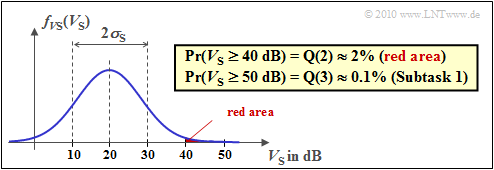
[[File:EN_Mob_A_1_2c.png|right|frame|loss due to lognormal fading]]
[[File:EN_Mob_A_1_2c.png|right|frame|loss due to lognormal fading]]
The graphic illustrates the result.
The graphic illustrates the result.
Zeile 91:
Zeile 87:
*If the distance-dependent path loss $V_0$ is reduced by $10 \ \ \rm dB$ to $\underline {70 \ \rm dB}$, a failure will only occur when $V_{\rm S} ≥ 50 \ \ \rm dB$.
*If the distance-dependent path loss $V_0$ is reduced by $10 \ \ \rm dB$ to $\underline {70 \ \rm dB}$, a failure will only occur when $V_{\rm S} ≥ 50 \ \ \rm dB$.
*This would achieve exactly the required reliability, as the following calculation shows:
*This would achieve exactly the required reliability, as the following calculation shows:
We consider a mobile radio cell in an urban area and a vehicle that is approximately at a fixed distance $d_0$ from the base station. For example, it moves on an arc around the base station.
Thus the total path loss can be described by the following equation:
The probability density $f_{\rm VS}(V_{\rm S})$ of the path loss due to shadowing (Longnormal–Fading) is shown here.
The probability that the system will fail is marked in red.
(4) From the availability probability $99.9 \%$ follows the failure probability $10^{\rm –3} \approx \ {\rm Q}(3)$.
If the distance-dependent path loss $V_0$ is reduced by $10 \ \ \rm dB$ to $\underline {70 \ \rm dB}$, a failure will only occur when $V_{\rm S} ≥ 50 \ \ \rm dB$.
This would achieve exactly the required reliability, as the following calculation shows: